
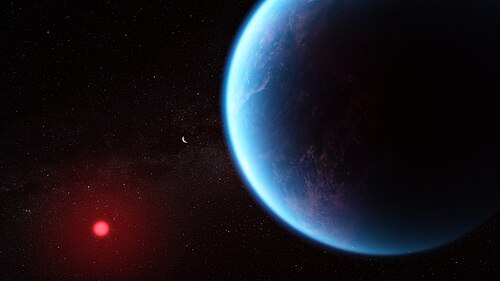
In a groundbreaking discovery, scientists using NASA’s James Webb Space Telescope have detected potential signs of life on exoplanet K2-18b, located 124 light-years away in the constellation Leo.
Researchers observed dimethyl sulfide (DMS) and dimethyl disulfide (DMDS) in the planet’s atmosphere—molecules that, on Earth, are primarily produced by marine microorganisms like phytoplankton.
These compounds, along with previously detected water vapor, methane, and carbon dioxide, point to a planet that may be capable of supporting life.
K2-18b is classified as a “Hycean” world—a planet with a hydrogen-rich atmosphere and possibly a global ocean. These conditions make it a prime candidate in the search for habitability beyond Earth.
However, scientists caution that while the detection is promising, further research is needed to confirm the presence of these compounds and rule out non-biological explanations. Still, the finding marks a major step forward in the quest to find extraterrestrial life.


